Vision Statement
“Fresno County is a place where opportunity is accessible to all, prosperity is shared, and a diversified economy supports resilient, thriving communities.“
CEDS Strategy Committee
Alicia Aguirre*
City of Selma
Nick Audino
Newmark Pearson Commercial
Sean Brewer
City of Coalinga
Chris Brown
Fennemore Dowling Aaron
Elizabeth Cabrera
City of San Joaquin
Gino Cayanan
Noble Credit Union
Ed Dunkel
Precision Civil Engineering, Inc.
Bryn Forhan
The Forhan Company
Karen Foster
Selma Chamber of Commerce
Thomas Gaffery
City of Fowler
Cristian Gonzalez
City of Mendota
Alex Henderson
City of Kingsburg
Esmeralda Hurtado
City of Sanger
John Jansons
City of Kerman
Simran Jhutti
Fresno Council of Governments
Bernard Jimenez
County of Fresno
Mike Kissinger
Kerman Chamber of Commerce
Rey León
City of Huron
Cassandra Little
Fresno Metro Black Chamber of Commerce
Jesus Martinez
CVIIC
Chad McCollum
City of Clovis
Jonathan Meza
Mendota Chamber of Commerce
Vong Mouanoutoua
Community Health System
Scott Netherton
Coalinga Chamber of Commerce
Lauren Nikkel
Fresno County Economic Development Corporation
Will Oliver
Fresno County Economic Development Corporation
Lisa Oliveira
Visit Fresno County
Nathan Olson
City of Sanger
Karen Pearson
Sanger Chamber of Commerce
Jolene Polyack*
City of Kingsburg
Julian Ramos*
Fresno County Economic Development Corporation
Jim Quan
Full Circle Renewables
Yvette Quiroga
County of Fresno
Guiding Principles





Business Growth
Foster a competitive business environment that supports the expansion of existing industries, attracts new investment, and drives innovation to create a resilient and diversified economy.
BUSINESS DEVELOPMENT
Advance business growth, retention, and expansion efforts throughout Fresno County by strengthening industry support, attracting investment, and fostering a competitive economic environment.
BUSINESS RECRUITMENT
Recruit new companies to Fresno County that offer high-quality jobs and are invested in the future of the region.
CBAs
Where required, or desired by the County of Fresno, utilize community benefit agreements (CBAs) to support economic development projects while ensuring workforce, environmental, and community benefits align with county priorities.
SMALL BUSINESS
Support the growth and success of Fresno County’s small businesses by improving access to resources, strengthening local networks, and fostering a business-friendly environment.
2. Workforce Development
Build a skilled and adaptable workforce to drive Fresno County’s economic growth and competitiveness.
CAREER DEVELOPMENT
Provide ongoing training and opportunities for workers to advance into high-quality and living-wage jobs.
WORKFORCE PIPELINE
Develop a robust workforce pipeline by fostering partnerships between education, industry, and community organizations to equip the future workforce with the skills to thrive in a dynamic economy.
WORKFORCE SUPPORT
Enhance workforce stability and productivity by addressing barriers to employment and ensuring access to essential resources for local talent. These efforts are complemented by the New Employment Opportunities (NEO) program—a collaborative, subsidized employment initiative between the Fresno County Department of Social Services and Fresno County Economic Development Corporation—which connects residents facing barriers to employment with paid work experience and skill-building opportunities.
TALENT ATTRACTION & RETENTION
Develop a talent attraction campaign that emphasizes Fresno County’s unique opportunities and its commitment to creating an environment that supports long-term career growth.
COLLABORATION & COORDINATION
Foster a collaborative ecosystem that brings together public, private, and nonprofit partners to align workforce development efforts, enhance industry-education connections, and ensure access to career opportunities across Fresno County.
3. Infrastructure & Real Estate
Develop and enhance the real estate and infrastructure assets needed to support business growth and strengthen the regional economy.
COMMERCIAL SITES
Enhance the readiness and marketability of commercial sites by streamlining development processes, modernizing existing properties, and fostering mixed-use and flexible workspace solutions that support business attraction and expansion.
INDUSTRIAL SITES
Expand industrial site availability and readiness through strategic inventory development, targeted infrastructure improvements, and the repurposing of underutilized properties to attract investment and support long-term economic growth. These efforts should be closely aligned with the Fresno County General Plan, which outlines long-term land use priorities and supports coordinated economic development across unincorporated areas.
UTILITIES
Develop resilient infrastructure systems that ensure reliable and sustainable water, electric, and broadband services to support economic and community growth.
CONNECTIVITY
Improve regional mobility and economic access by expanding public transit, enhancing highway and rail infrastructure, and supporting the growth of Fresno Yosemite International Airport as a transportation hub.
4. Quality of Place
Elevate the region’s quality of place by creating vibrant, resilient communities that attract talent and visitors and support local businesses.
HOUSING
Support affordable, diverse, and sustainable housing development in Fresno County to support workforce growth, attract new residents, and drive long-term economic vitality.
DOWNTOWNS
Strengthen the vitality and development of downtowns, central business districts, and Main Streets across Fresno County.
COMMUNITY IDENTITY
Preserve and promote the authenticity of the community by supporting local culture, historic assets, and unique public spaces that strengthen identity and sense of place.
GREENSPACE
Integrate greenspaces into current and future developments to enhance recreation, connect popular destinations, and support sustainable development through parks, trails, and non-motorized corridors.
SWOT Analysis
During the discovery phase of the project, the consulting team gathered qualitative input from stakeholders in Fresno County concerning issues affecting local economic development. In addition, TIP conducted quantitative data analyses to understand the County’s competitive position in the region. The results of these efforts formed the basis of the strengths, weaknesses, opportunities, and threats (SWOT) analysis.
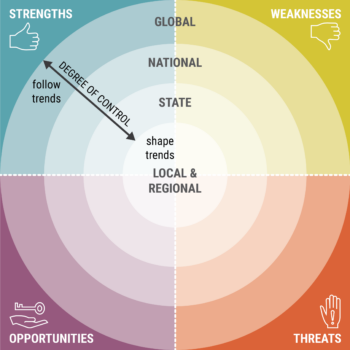
As part of the analysis, the consulting team considered the County’s degree of control, an approach that is illustrated in Figure 16. While it is important to be mindful of the impact of
external factors and trends and respond where possible, this method ensures that resources are focused on maximizing strengths and opportunities the County and its cities can realistically influence.
Findings from this work directly shaped the CEDS objectives and the associated strategies and action items. Building on the SWOT analysis allows the CEDS to better connect the dots between these essential questions: Where does Fresno County stand now? Where does it want to go? How will it get there? The CEDS strategic framework demonstrates these connections by building on the County’s strengths, such as its strong agricultural history, while addressing immediate and long-term challenges, including job losses in the agricultural sector. This approach highlights the need to leverage opportunities, such as investing in innovation, to drive economic diversification.
Internal
High Degree of Control (Local, Regional, State)
External
Low Degree of Control (National, Global)
• High-quality K-12 education systems
• Robust agriculture cluster
• Strong distribution & logistics (D&L) sector
• Urban and rural lifestyles
• Success in securing major grants (demonstrated partnerships)
• Renewable energy developments
• Diverse population
• Network of higher education assets (serves local population)
• Collaborative cross-sector initiatives (Fresno State’s ABE, F3, Good Jobs Challenge, etc.)
• High-quality healthcare providers
• National parks and forests
• Geographic location
• Visibility/profile of California
Internal
High Degree of Control (Local, Regional, State)
External
Low Degree of Control (National, Global)
• High percentage of low-wage jobs
• Lack of access to high-quality and affordable childcare
• Infrastructure lags site development (especially electricity & utilities)
• Lack of resilient infrastructure (i.e., lack of groundwater recharge, water quality systems)
• Low supply of housing
• Educational attainment varies across the County (skills gap)
• Lack of intermodal facility for ag D&L
• Innovation assets (agtech, healthcare, Fresno State
• Long permitting processes
• Water scarcity
• Escalating utility costs
• Rising insurance costs
Internal
High Degree of Control (Local, Regional, State)
External
Low Degree of Control (National, Global)
• Innovation assets (agtech, healthcare, Fresno State/WET Center)
• Economic diversification, foreign direct investment
• Fresno Yosemite International Airport growth
• Inland port
• Career exposure
• D&L industry expansion (hub)
• Outdoor recreation (assets and innovation)
• Quality of place initiatives (downtown/main streets revitalization, parks, etc.)
• Workforce development (upskilling)
• Enhanced countywide coordination and collaboration
• Intra-county transportation improvements
• Talent attraction and retention
• Agri-tourism {Food Trail, Blossom Trail, wine industry, etc.)
• Broadband infrastructure
• National investments/policies toward reshoring
• Manufacturing investments
• Infrastructure funding (including high speed rail)
• California statewide energy plan
Internal
High Degree of Control (Local, Regional, State)
External
Low Degree of Control (National, Global)
• Water quality
• Loss of agriculture jobs
• Aging infrastructure, investments not keeping pace with growth
• Fallow land
• Shortage of training staff (e.g., nurses can make more in a clinical setting than teaching)
• Talent out migration
• Extreme or unprecedented weather patterns
• Trade policy
• Regulations and policies
• Water availability
• Automation impacts on labor (especially in ag and D&L)
• Consolidation of family farms into global conglomerates
• Federal funding programs and opportunities
Downloads